Friday, September 21, 2012

Jaguar XJ Ultimate, 2013


  •  Jaguar XJ Ultimate, 2013

The flagship Jaguar XJ ushered in a new interpretation of the company's established reputation for dramatic design and - with its lightweight aluminium architecture - responsible performance. Now, the XJ Ultimate focuses on two further Jaguar hallmarks: innovation and luxury, extending the model's emotive appeal.

Based exclusively on the long-wheelbase XJ, the interior changes applied to the Ultimate focus on the rear accommodation, extending the car's limousine remit to provide a fully-appointed luxury business class experience for the most discerning of global customers. The Jaguar XJ Ultimate offers the appointments of a private jet in a package to suit a wide range of requirements.

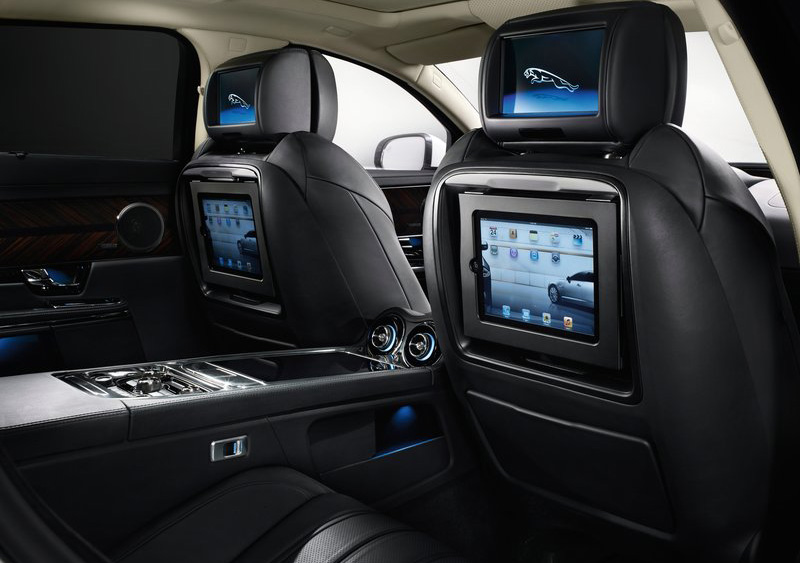
A full-length, leather-trimmed centre console separates the two individually tailored rear seats which feature power adjustment, ventilation, massage and lumbar functions. A table, machined from solid aluminium with piano-black and chrome detailing, rises up from the centre console at the touch of a button to provide a working area, its role supplemented by the provision of two third-generation iPads® with wireless keyboards that are housed in bespoke leather-trimmed docks in the rear of the front seats.

Switching the focus from business to pleasure is the bespoke champagne chiller mounted between the two rear seats. This cools the bottle to what experts agree is the perfect temperature before 'presenting' it forwards when the chiller is opened. Two specially commissioned champagne flutes reside in a purpose made cabinet beneath the centre table.

A full rear seat package with twin headrest screens and wireless headphones completes the experience in combination with a new 20-speaker surround sound in-car entertainment system developed by British audio expertsMeridian.

To underline its purpose in ensuring that passengers remain cosseted at all times, the Jaguar XJ Ultimate features revisions to the suspension to optimise rear ride comfort, with no compromise to the car's breadth of dynamic ability.

The exterior detailing of the Jaguar XJ Ultimate offers discreet clues to the model's figurehead status with sculpted lower air intakes chromed to match the grille, polished stainless steel oval exhaust pipe finishers, unique dual-surfaced alloy wheels and subtle 'Ultimate' badging.

The XJ Ultimate is available with Jaguar's existing 5.0-litre V8 supercharged petrol engine, its powerful and efficient 3.0-litre V6 turbocharged diesel, and a new 3.0-litre V6 supercharged petrol unit, all driving the rear wheels via an eight-speed transmission.

EXTERIOR
The Jaguar XJ introduced a mouldbreaking coupé design ethos to its class, taking Jaguar's established principle of long, unbroken feature lines and applying them to a decidedly 21st century form. Dramatically different from its competitors, the all-aluminium XJ captures the essential Jaguar design elements of elegance, muscularity, sleekness and strength.

The detail changes applied to the Jaguar XJ Ultimate serve to subtly enhance the inherent rightness of the car's design, making it clear that this is the luxurious flagship of the range.

The lower front air intakes are reshaped and chrome finished, matching the powerful Jaguar grille, while LED daytime-running lights underline the assertively shaped headlamps.

The 20-inch Maroa forged alloy wheels are unique to this model and feature a dual-tone colour scheme. A dark grey, technical finish is applied to the inner surfaces of the spokes which contrasts with the bright, polished surfacing on the outer edges, combining to create an appearance that is both glamorous and purposeful.

Anyone following an Jaguar XJ Ultimate will be in no doubt that the model is a cut above, as it is distinguished by new oval tailpipe finishers in polished stainless steel that echo the front air intakes and a discreet metal 'Ultimate' badge underneath the 'XJ' nameplate. The 'Ultimate' badging is repeated in the power vents set into the front fenders.

The first 20 Ultimate models made will be painted in Celestial Black, but customers can also order their car in Polaris White - and any colour in between. In addition to an exclusive extended palette of paint colours, including a new 'chromaflare' range, XJ Ultimate customers can order their car colour-matched to any shade of their choosing on provision of a suitable sample for a true bespoke experience.

INTERIOR
Jaguar has always prided itself on creating unique cabin environments and the interior architecture of the XJ is like no other, combining graceful and unexpected forms with quality materials that reward the senses with their tactility, visual splendour and luxury.

Unique finish and personalisation
Now, the Ultimate's position as the XJ range's luxury flagship is apparent from the moment the door is opened. A unique wood veneer, crafted using straight ebony, has been formed into a Herringbone pattern with mirror image upper and lower halves separated by a strip of piano black veneer. The Herringbone pattern forms fillets in the doors and at the front of the car runs around the base of the windscreen to create a dramatic feature that mimics the form of classic wooden-hulled power boats. The clock mounted in the dashboard is also unique to the model with a brushed aluminium face, embossed lozenge detail and 'spun' bright finish.

The Jaguar XJ Ultimate is offered in three interior colourways for the sumptuous leather that covers virtually every surface and is also used for the headlining; Jet on Jet, or Ivory seats and lower surfaces with either Mineral orBordeauxuppers.

Further personalisation is offered through customers being able to specify the headrests embroidered with a pattern of their choice. The 'Ultimate' intaglio which sits in the centre of the sweep of Herringbone veneer under the windscreen can also be changed to read whatever the owner wishes.

The Jaguar XJ Ultimate brings a particular focus to the rear seat passengers to create an ambience that carefully balances the requirements of the modern, on-the-move businessperson with certain surprise-and-delight features that underline the XJ's 'work hard, play hard' personality and reward the discerning owner who appreciates the sense of fun with which Jaguar imbues all its products.

Tailored rear seating
In the Ultimate the XJ's standard rear bench has been replaced by two unique and individual seats designed specifically for this model. Elegant, cosseting and ergonomically optimised, the tailored seats are covered in semi-aniline leather which offers a more luxurious and tactile finish and allows the hide to retain its essential qualities of look and feel, complemented by the hand-finished stitching.

The seats feature winged headrests, powered recline and four-way lumbar adjustment functions to allow passengers to achieve the seating position perfect for them. The comfort levels offered by the seats are enhanced through the inclusion of on-demand massage, heating and cooling functions.

The occupant positioned behind the front passenger seat is also provided with a stow-away button that automatically powers the empty chair forwards to increase still further the XJ's generous legroom. The front seats follow the same unique design as the rears and offer identical functions with an additional range of electric movement allowing 20 by 20 adjustment.

The seats are divided by a centre console running along the length of the car. Fully trimmed in soft-grain leather, piano black veneer and chrome, the console houses a number of features exclusive to the XJ Ultimate. At the touch of a button a table machined from a solid piece of aluminium with a gloss black and chrome finish rises up to then be pivoted into position in front of whichever passenger requires its use.

Chilled to Perfection
Raising the table reveals the first of the Jaguar XJ Ultimate's surprise and delight features, a pair of champagne flutes in a bespoke recess flock-lined in either Mauveine or Jet and lit by phosphor blue ambient lighting. Within the centre console are 'fluteholders', designed specifically for these glasses and machined from solid aluminium.

The flutes are, of course, there for a reason: discreetly integrated between the rear seat backs, covered in soft-grain leather and marked by a chrome Jaguar leaper is a hidden champagne chiller. Lined in the same flock as the champagne flute recess to give the impression of a bespoke suit lining, it holds one standard sized champagne bottle which, when the cabinet door is opened, is effortlessly presented forwards to the passengers. The champagne is kept perfectly chilled at the optimum temperature range of 7°C-10°C.

TECHNOLOGY
Rear-seat passengers are also provided with a range of entertainment options to enjoy while sipping their champagne. The Jaguar XJ Ultimate is fitted as standard with Jaguar's Rear Seat Entertainment package which comprises two eight-inch high-resolution screens mounted on the back of the front seat headrests.

These can display inputs from a number of sources; the DVD player, digital TV tuner or an external media player that can be synced through the Rear Media Interface, which provides USB and RCA connections. Sound can be provided through the wireless headphones, allowing each passenger to watch separate entertainment sources.

The rear seat environment, including the entertainment, is managed by a wireless controller housed in the centre console and which also allows passengers to alter their individual climate zones and seat heating and cooling functions.

Meridian Surround Sound
The Jaguar XJ Ultimate is also fitted as standard with the latest generation of in-car audio systems. Specifically developed for the XJ by British ultra-premium audio expertsMeridian, marking a new partnership for Jaguar, the Meridian Surround Sound System fitted to the XJ Ultimate uses the latest technological developments to deliver music reproduction that is second to none.

Unlike other manufacturers,Meridiandesigns and manufactures audio systems that combine innovative technology with the most natural of approaches: comparing their musical reproduction to the sound of the original musical performance.

The 15-channel amplifier, 20-loudspeaker system featuresMeridian's unique digital sound processing technology that allows every person travelling in the Jaguar XJ Ultimate to enjoy a musical experience that places them in the centre of the sound field.Meridianachieves this through its Trifield technology which creates an all-enveloping sound field that makes each listener feel that the music is exclusively focused on him or her.

Meridian technology achieves a level of natural detail, realism and performance usually associated with speakers eight times the physical volume. Meridian Cabin Correction and Dynamic Volume Control precisely and effortlessly minimise resonances and monitor extraneous noise levels to allow the audio to be unobtrusively maintained at a constant volume in order for it to be perfectly heard whatever the circumstances.

iPad Integration
In addition to the entertainment on offer, the XJ Ultimate also provides a pair of third-generation iPads® with wireless keyboards. The iPads® are housed within specially designed leather-trimmed docks in the rear of the front seats and hidden behind roller doors, also finished in tailored leather. The iPads® are automatically kept charged whenever the ignition is on and also included in the cabinets are wireless keyboards to allow the tablets to be used without being removed from their docks if required.
Read More

Thursday, September 20, 2012

Skoda Citigo, 2013


  •  Skoda Citigo, 2013
Ĺ koda is continuing its growth offensive by introducing its seventh model line. Citigo is the name of Ĺ koda's new small vehicle. The brand's new model will make its debut in its domestic market, the Czech Republic, before the end of this year, with other European countries following at the beginning of summer 2012. With this 3.56-metre-long vehicle, the Czech-based car maker is extending its product portfolio and entering the small vehicle segment (A00). Offering maximum utilisation of space and four seats for passengers, the Ĺ koda Citigo  launched as a three-door, with a five-door version to come in 2012.

With the Citigo, Ĺ koda is targeting a new customer segment. "The demand for small cars with low fuel consumption, at a favourable price and with reasonable operating costs, is growing," continues Prof. Vahland. "Ĺ koda's new small vehicle is a reaction to this trend. We are entering new ground and the Ĺ koda Citigo will attract prospects mainly in our European markets."

The design of Ĺ koda's new city car includes many elements typical of all its vehicles. The designers managed to give the car a distinct look that declares at first glance: this is the new Ĺ koda. The finned grille set in a chrome-plated frame and precisely shaped headlamps give the car the typical Ĺ koda look. The designers have done a fantastic job on the rest of the car's body - 3.56 metres long, 1.65 metres wide and 1.48 metres high, the Ĺ koda Citigo is one of the smallest vehicles in its segment.

The key target groups are young drivers, young families with young children looking to get themselves a second or even third car, and also 'best agers', i.e. customers who are rather cost-sensitive and have a rational approach to cars on one hand but high demands for quality, design and safety on the other. The Ĺ koda Citigo is a perfect mix of these properties. Depending on market demands, up to four trim options will be available: Easy, Active, Ambition and Elegance.

In line with its motto 'City Clever', the Ĺ koda Citigo is an ideal car in and out of the city. It offers surprisingly generous interior space, a thing that is not taken for granted in the small vehicle segment, but is typical for Ĺ koda models. The car's long wheel base - 2.42 metres - provides enough comfort for four passengers even on long trips. The volume of the luggage compartment is 251 litres and can be extended to 951 litres by folding down the rear seats.

The Ĺ koda Citigo's interior offers space, quality and precision, thanks to the clear and transparent arrangement of all elements as well as the two-colour dashboard in higher trim levels. The front headrests are integrated into the seats, as well as a number of other smart solutions, make the new Citigo a 'simply clever vehicle' Ă  la Ĺ koda. The interior design includes numerous storage compartments, cup holders and multimedia systems, as well as storage pockets on the sides of the front seats. In addition, a special handbag hook integrated in to the glovebox opening mechanism, and a photograph holder on the central console, are two clever interior elements. In the luggage compartment a pop-out storage rack can be locked in its top position, and a set of nets prevents loose objects from sliding around.

The vehicle boasts a number of solutions to provide overall comfort. In the three-door version, the 'Easy Entry' system allows easy access to the rear seats. The front passenger's seat can be moved and folded forward to ensure easy access to the rear seats.

The Ĺ koda Citigo places great emphasis on safety. For the first time in a Ĺ koda vehicle, the designers have used a Head-Thorax side airbag to protect the heads of both the driver and the front seat passenger. Along with a number of other items, this system is part of a safety package that is impressive for this segment. In addition, active safety is enhanced by the 'City Safe Drive', a new brake assistance system based on a laser sensor that is activated automatically at speeds below 30 km/h to identify a danger of collision. Depending on the speed and the traffic situation, this automatic braking solution may completely prevent a collision or at least reduce its seriousness. The risk of bumping into the car ahead is thus reduced significantly in city traffic. Along with the Volkswagen up!, the Ĺ koda Citigo is currently the only car in the small vehicle segment to offer the emergency braking functionality.

Two new, three-cylinder 1.0-litre petrol engines available after the Ĺ koda Citigo's launch (44 kW/60 HP and 55 kW/75 HP). The engines and the transmission have been designed to provide optimum economy in cities and their surroundings. Reaching the operating temperature even on short distances, the engines are highly economical. The highly economical Green tec version offers an average consumption of 4.2 l/100km and 4.3 l/100km respectively; with emissions of 97 g and 99 g CO2/km respectively. The fuel consumption and emission levels are indeed low - 4.5 l/100 km and 105 g CO2/km with the 44 kW engine and 4.7 l/100 km and 108 g CO2/km with the 55 kW unit.
Read More

Porsche Cayman S Black Edition, 2012


  • Porsche Cayman S Black Edition, 2012

The new Porsche Cayman S Black Edition combines performance and style, with a 3.4-litre flat-six engine tuned to deliver 330 hp, distinctive 19" alloy wheels finished in black and a luxurious interior. Production is limited to 500 examples worldwide, and UK sales begin in September 2011.

The extra power is produced at 7,400 rpm (an additional 200 rpm vs the standard car), while the maximum torque remains unchanged at 370Nm at 4,750 rpm. This extra horsepower feeds directly through into the performance of the all-black mid-engined two-seater. Acceleration from 0-62 mph (0-100 km/h) is improved by a tenth of a second to 5.1 seconds with the six-speed manual transmission, and to 5.0 seconds with the optional Porsche Doppelkupplungsgetriebe (PDK) respectively. With the Launch Control activated on the PDK Sport Chrono package option, acceleration improves further to 4.8 seconds.

The top speed of the Porsche Cayman S Black Edition is just over one mph faster than that of the Cayman S - 173 mph (279 km/h) with the manual transmission and 172 mph (277 km/h) with PDK. In line with the Porsche Intelligent Performance principles, fuel consumption of the Porsche Cayman S Black Edition remains identical to that of the standard car, despite the increase in horsepower. The Porsche Cayman S Black Edition with manual transmission returns 29.7mpg Combined, and 30.1mpg Combined with PDK. Likewise, CO2 remains 223g/km for the manual and 221g/km for the PDK.

Helping the dynamic performance of the Porsche Cayman S Black Edition further still are the lightweight Boxster Spyder wheels finished in black which, with a diameter of 19 inches, are one inch bigger than the standard Cayman S wheels and also half an inch wider than the optional 19 inch wheels offered on the Cayman S. The tyre sizes fitted are 235/35 ZR 19s on the front axle and 265/35 ZR 19s on the rear axle.

The Porsche Cayman S Black Edition features as standard Bi-Xenon headlights with dynamic cornering lights and LED daytime running lights, together with automatic anti-dazzle interior and exterior mirrors with integrated rain sensor.

The front seats are trimmed in black partial leather with a Porsche crest on the headrests, as well as a Sport Design steering wheel. Climate control and cruise control add to the overall comfort. A further highlight of the Black Edition interior is the Porsche Communication Management (PCM) incorporating satellite navigation. This is combined with the universal audio interface that allows MP3 player connectivity and also Bluetooth mobile phone compatibility.

The colour scheme of the Porsche Cayman S Black Edition is consistent throughout: the dashboard trim is black as are the gear lever/selector trim and the dials in the instrument cluster. The door entry guards feature "Black Edition" lettering and are made of stainless steel; the glove compartment lid bears a badge highlighting the limited edition status.

The Porsche Cayman S Black Edition costs from £50,420 (67,807 euro in Germany including VAT) and is on sale in the UK from September 2011. Customers will also be able to explore the potential of their new car by participating in a complimentary course at the Porsche Experience Centre, Silverstone.
Read More

Wednesday, September 19, 2012

Peugeot 2008 Concept, 2012


  •  Peugeot 2008 Concept, 2012

Forging ahead with a competitive position in the B segment, Peugeot has extended its traditional position with a new, broader, all-encompassing approach. So, the 208 was designed in accordance with an ambitious specification to re-generate the small hatchback. It on sale in Europe at the end of March 2012, and in the UK at the end of June, prior to an industrial and commercial launch in Latin America in 2013.

In Beijing in early 2012, Peugeot revealed the Urban Crossover Concept to the Chinese public, a contemplation of the motor vehicle in an increasingly urban world.

At the 2012 Paris Motor Show, the Marque is presenting the Peugeot 2008 Concept. The concept car gives further thrust to its international conquest strategy, for which all its talents have been mobilised. The engineers and stylists have worked together in Europe, China and Latin America to create this seductive future vehicle of the range.

The city and Peugeot evolve together
From Sao Paulo to Shanghai, from London to Kuala Lumpur, from the Cape to Moscow, the city lives, evolves and grows. The human race is becoming increasingly urban, at a rate not seen before. A new generation of city dwellers is coming alive. Connected, curious, they share numerous aspirations, regarding the way in which they keep themselves informed of news occurring across the Planet.

Peugeot has included several continents in the development of a new concept car with a view to marketing to an international clientele. So, for them, with them, the Peugeot Style teams in Paris, Shanghai and Sao Paulo have all created the Peugeot 2008 Concept. It go into production, as close as possible to its customers, first in France (Mulhouse) then in China (Wuhan) and later in Brazil (Porto Real).

The Marque mobilises its experience
With more than 15 million '2' series vehicles, Peugeot benefits from a credible history in the domain of compact cars. This is further reinforced by the new 208, which has re-generated the codes of the segment. Recently, the marque has acquired legitimacy in the domain of the Crossover, with the commercial success of the 3008 and the inspiration drawn from the SXC Concept Car shown at the Shanghai Motor Show in 2011.

Wishing to merge these two fields of excellence into a new vehicle, Peugeot has developed the Peugeot 2008 Concept, a small vehicle combining agility, compactness, versatility and a striking style for young-minded city dwellers who love the city, while also loving to escape from it.

Its unique identity originates from the marriage of the elegance and refinement of the hatchback, the impertinence and mischievousness of the SUV combined with remarkable versatility and occupant space for this segment. Capitalising on the process of re-generation unveiled by the 208, the urban nature of the Peugeot 2008 Concept is established by compact dimensions: 4.14m long and 1.74m wide.

A unique style, combining elegance and strength
The Peugeot 2008 Concept naturally bears the stylistic codes of the Marque. With its athletic and sleek lines it imposes its bold posture which overturns and reinvents the standards of the larger vehicles in the small-vehicles segment.

It is painted fluorescent yellow with Velvet matt varnish, a very luminous colour which is full of energy. The body is punctuated with Dark Chrome details, accentuating the modernity and elegance of this concept car.

From a coherent overall volume the Peugeot 2008 Concept succeeds in combining a variety of impressions. The front face is refined and full of presence, where bonnet and wings give a reassuring impression of protection and strength. This perception is identical at the rear where the shape combines solidity with dynamism. The profile unites the two faces by means of the slender link which begins with the inclined windscreen and continues with the continuous roof line to the spoiler. And so a profiled and very aerodynamic silhouette is outlined. The side lines, traced in the direction of the road, give the impression of a lively, sleek and dynamic vehicle.

The Peugeot 2008 Concept pays particular attention to detail. The 'floating grille' has a design cut into the metal, combined with a sophisticated dual-aspect treatment following the example of the new marque emblem. The headlamps, of a precise and unique design, bear the Peugeot identity. Their contours follow the technical functions as closely as possible and so form the sharp pupil of a cat. Chiselled in form, they are aligned with the front face, giving it an even more expressive and individual character.

The Peugeot 2008 Concept also has very sensuous and sophisticated sculpted wings and sides, indicating natural athletic qualities. The large wheels, the design of their wheel arches and the ground clearance symbolise an active life without restraint; agile, versatile and lightweight.

In profile, the curve of the roof accentuates the upper decoration of the rear doors. Exclusive, cut into the metal, it appears crimped into the bodywork. This refinement also marks the precise design of the aluminium spoiler and roof bars which give the appearance of a vehicle designed for speed and leisure.

A 3-cylinder turbo petrol engine
Under its sleek bonnet the Peugeot 2008 Concept is equipped with a development of the new generation 3-cylinder petrol engines. In harmony with the dynamism and power exuded by this concept car, the 1.2-litre 3-cylinder engine has a turbo and direct injection. Developing its energy while remaining lightweight, it contributes to the versatility of the 2008 Concept with a power of 110bhp. This is combined with low fuel consumption and CO2 emissions.

Components of the Group's down-sizing strategy, these 3-cylinder engines permit a breakthrough in terms of consumption and CO2 while offering real driving pleasure.
Read More

Porsche 918 Spyder Prototype, 2012


  •  Porsche 918 Spyder Prototype, 2012

The Porsche 918 Spyder is on the road: Dr. Ing. h.c. F. Porsche AG, Stuttgart, has taken the driving trials of the super sports car of the future a step further with completion of the initial prototypes. The Porsche 918 Spyder go into production at the end of September 2013 as planned, with the first customers receiving their vehicles before 2013 is out. "What we are doing with the 918 Spyder is redefining driving fun, efficiency and performance," said Wolfgang Hatz, Member of the Executive Board Research and Development of Porsche AG.

The prototypes, their camouflage harking back to historical Porsche 917 racing cars, signal the final touches to the Porsche 918 Spyder. The focus is on the interplay between the highly sophisticated individual drive components. The combination of combustion engine and two independent electric motors - one on the front axle and one in the drive line, acting on the rear wheels - poses completely new demands on the development of the operating strategies. "They are therefore a critical component in this vehicle into which we have put all of our expertise and capacity for innovation," said Wolfgang Hatz. These operating strategies and the development of the software to go with them are one of Porsche's core competences. Both of them have a major influence on the extreme driving fun to be had with the 918 Spyder and they make possible a unique combination of minimal fuel consumption and maximum performance. The initial results of the driving trials are in line with the high expectations placed on the Porsche 918 Spyder.

The super sports car is designed as a plug-in hybrid vehicle combining a high-performance combustion engine with cutting-edge electric motors for extraordinary performance: on the one hand, the dynamics of a racing machine boasting more than 770 hp, on the other hand, fuel consumption in the region of three litres per 100 kilometres. Moreover, Porsche is breaking yet more new ground with the technology demonstrator with spectacular solutions such as the full carbon fibre reinforced plastic (CFRP) monocoque with unit carrier, fully adaptive aerodynamics, adaptive rear-axle steering and the upward-venting "top pipes" exhaust system. In the process, the Porsche 918 Spyder is offering a glimpse of what Porsche Intelligent Performance may be capable of in future.

Technical Specifications
    Body: Two-seater Spyder; carbon fibre reinforced plastics (CFRP) monocoque interlocked with CFRP unit carrier; two-piece Targa roof; fixed roll-over protection system.
    Drivetrain: Parallel full hybrid; 4.6-litre V8 mid-engine with drysump lubrication; hybrid module with electric motor and decoupler; electric motor with decoupler and gear unit on front axle; electrical system recuperation; four cooling circuits for motors, transmission and battery; thermal management.
    Engine Power
        V8 engine: >570 hp
        Hybrid module on rear axle: ~90 kW
        Electric motor on front axle: ~80 kW
        Combined: >770 hp
    Suspension: Double-wishbone front axle; optional electro-pneumatic lift system on front axle; electro-mechanical power steering; multi-link rear axle with adaptive electromechanical system for individual rear wheel steering
    Brake system: High-performance hybrid brake system with adaptive recuperation; ceramic brake discs (PCCB).
    Energy supply: Lithium-ion battery with 6.8 kWh capacity (BOL nominal), 202 kW maximum power and mainscompatible plug-in charger.
    Performance
        Top speed: >325 km/h
        Purely electric top speed: >150 km/h
        0-100 km/h: under 3.0 s
    Fuel Consumption (NEDC): ~3.0 l/100 km
    CO2 emissions: ~70 g/km
    Purely electric range: >25 km
Read More

Tuesday, September 18, 2012

Mini Clubvan Concept, 2012


  •  Mini Clubvan Concept, 2012

Stand-out-from-the-crowd style can also be amazingly practical - and practicality surprisingly attractive. The MINI Clubvan Concept brings apparently conflicting profiles together into a single package, paving the way for an innovative vehicle concept without parallel in the premium small car segment. The MINI Clubman-based concept car, scheduled for its world premiere at the Geneva International Motor Show 2012, combines the driving fun for which MINI is renowned with increased load-carrying capability. The MINI experience will therefore find its way into new areas of life, the brand's distinctive character gaining new popularity among target groups not previously on the MINI radar.

The closed-off load area behind the front seats and the opaque rear side windows of the new concept set it apart most strikingly from the MINI Clubman. The MINI Clubvan Concept uses its broader skill-set to open up new usage possibilities - both business and leisure. Where a business's customers, product range and operating environment demand a particular style for its vehicles, a premium model can make the perfect delivery solution. For example, a car in the mould of the MINI Clubvan Concept would fit excellently into the fleet of a fashion designer, art gallery owner or event caterer. And its abilities as an all-rounder also tick the right boxes for a photographer with a stack of camera, tripod and lighting equipment to ferry around during the week - and bulky sports and leisure gear to pile on board at the weekend.

The MINI Clubvan Concept pulls off the trick of blending enhanced practicality and a well-judged lifestyle focus with natural ease. This ability is based on the impressive adaptability that goes to the heart of the MINI brand's heritage. Calls for maximising the load capacity of the classic Mini began as early as 1960, just a year after the car's birth. And they were soon heeded. With its 10-centimetre-longer wheelbase, separate load compartment and split rear doors, the Morris Mini Van was perfectly equipped for commercial use. It also provided the basis for the fully glazed, four-seat Morris Mini Traveller, one of the precursors of today's successful MINI Clubman. And so, more than 50 years on, the MINI Clubvan Concept sees history repeating itself - albeit in a slightly different order.

Two seats, five doors, endless usage potential
Limiting the car to two seats creates the capacity its need on a day-to-day basis, as well as opening up a whole new world of customisation potential. The load compartment of the MINI Clubvan Concept embodies the car's fresh and rigorous interpretation of the principle used in the classic Mini - of providing the maximum amount of interior space on the smallest possible footprint. The load area reaches from the split rear doors right up to the partition grille behind the two seats. The totally level floor makes full use of the interior's depth, and that allows the concept car's load capacity to exceed the maximum achieved by the MINI Clubman.

Six attachment loops recessed into the load compartment floor use elasticated straps to hold items of varying lengths, heights and widths in place - without the risk of them sliding around. Added to which, the partition grille, which is fixed securely to the car body, ensures that items stowed in the load compartment cannot find their way into the front seats, even under extremely heavy braking. The lower section of the partition is made from solid aluminium, while the upper section consists of a silver-coloured stainless steel honeycomb grating. The side walls and floor of the load compartment are trimmed in high-quality anthracite-coloured cloth. The anthracite roof liner, meanwhile, extends along the full length of the interior. This uniform colour scheme emphasises the pure-bred, practicality-oriented character of the MINI Clubvan Concept.

Like the MINI Clubman, the MINI Clubvan Concept is a five-door car with a twist. Two front doors for the driver and front passenger, two side-hinged doors at the rear and the rear-hinged Clubdoor on the right-hand side create comfortable access to the interior. The Clubdoor gives owners the option of loading or unloading smaller items from the side of the car as well as the rear.

The generous levels of space on board the concept car can be exploited in a variety of ways. Commercial users will be particularly pleased to discover the scope for configuring the load compartment to personal requirements. For example, tools and goods can be stored neatly and securely in made-to-measure drawers or shelving units. 12-volt plug sockets in the rear area of the load compartment provide additional practicality.

Exterior design: shields from prying eyes, cuts a distinctive figure
Impressive practicality and the brand's time-honoured style lend the MINI Clubvan Concept its unmistakable character. Sharing the exterior dimensions of the MINI Clubman and boasting cleverly increased storage capacity, the concept car is the first premium model in the small car-based van segment. The exterior appearance of the MINI Clubvan Concept marks it out immediately as a MINI - and therefore as a premium product. The function-led design modifications have no impact on the car's proportions and hallmark MINI design language, but they do give customers the opportunity to combine the demands of commercial use with an appreciation of individual style.

The MINI Clubvan Concept comes with British Racing Green exterior paintwork, which extends to the roof, C-pillars and exterior mirror caps. As is usual for vehicles charged with transportation tasks, the rear side windows of the MINI Clubvan Concept are opaque. Polycarbonate sections - their outer surfaces painted in the car's body colour - and heavily tinted glass for the rear doors make it difficult to see into the load compartment.

The unbroken paintwork along the car's flanks offers extensive scope for individualisation, which the MINI Clubvan Concept highlights to eye-catching effect. The sealed side windows bear the logo of a sign design company based in the MINI's native Great Britain. The hand-applied graphics lend the vehicle a personal look. Indeed, the ultra-versatile MINI carries both its cargo and the company's promotional message with a uniquely stylish verve. The MINI Clubvan Concept presented in Geneva lends this form of customisation a piquant authenticity - on two fronts. The British company that has literally left its stamp on the MINI Clubvan Concept creates similar vehicle graphics for its customers. And the MINI Clubvan Concept showcases how these might look when applied to a MINI van.
Read More

Volvo S60 Polestar Concept, 2012


  • Volvo S60 Polestar Concept, 2012

The Volvo Cars Official Motorsport and Performance partner Polestar present the Volvo S60 Polestar Concept, a performance concept car developed with the aim of satisfying the performance minded driver.

The main focus when developing the car has been to combine a comfortable genuine Volvo driving experience with a high level of power and handling. The Volvo T6 engine has been tuned to deliver a considerable increase in power and torque. This, in combination with a lowered, widened and reinforced chassis together with a tuned Haldex all-wheel drive system and Ă–hlins suspension makes the car suitable for both high performance driving and long distance travelling.

The car presented at Gothenburg CityArena is the first car built for one specific client. A small series of Polestar modified S60s may be built pending market response;

Technical specification
    Performance
        0-100 km/h: 3.9s
        Top speed: >300 km/h
    Engine
        Volvo T6 inline six (B6304T4)
        508 hp @ 6500rpm
        575Nm @ 5500rpm
        Max rpm: 7100
        Modified cylinder head and combustion chambers
        Modified inlet manifold and air intake
        Special manufactured conrods
        Garret 3171 turbo
        Ferrita 3.5" stainless steel exhaust system
    Drive train
        Reinforced M66C (close ratio) manual 6-speed gear box
        Haldex E-LSD in rear
        Haldex Gen4 XWD
    Chassis
        Tires 265/30R19
        Rims Polestar 9,5X19"
        Chassis lowered 30mm
        Ă–hlins 3- way shock absorbers
        Reinforced anti-roll bar front and rear
        Track width increased 20 mm front and 40 mm rear
        Polestar-tuned EHPAS steering
        Stabilising X- members, front and rear
        Modified control-arms with uniballs front and rear
        Reinforced bushings in sub-frame and control-arms
        Modified engine mounts
    Weight
        Total weight 1640kg and optimized weight distribution
    Brakes
        Front Polestar-Brembo 6 piston calipers, 380 mm ventilated discs
        Rear Polestar-Volvo calipers, 302 mm ventilated discs
        Brake cooling air intakes from front
    Aerodynamics
        Based on tests in Volvo's wind-tunnel
        Lowered front splitter and larger rear spoiler to reduce high speed lift
        Carbon fiber diffusor
        Body 20 mm widened front and rear
    Interior
        Polestar designed seats with increased support. Alcantara on all functional areas steering wheel, gear knob, and seats to ensure maximum grip.
        Centre console lowered for optimised gear-lever ergonomics.
Read More