Friday, April 13, 2012

Rinspeed Dock-Go Concept, 2012


Rinspeed Dock-Go Concept, 2012

Swiss automotive visionary Frank M. Rinderknecht isn't hiring out as an experienced travel consultant these days who has seen much of the world. Rather the man from Zumikon near Zurich is simply pointing out that usually all of us automatically do the right thing when we move around: we lug around as little ballast and unnecessary items as possible. And it is precisely this from an economic and ecological standpoint sensible behavior that Rinderknecht echoes with his new Rinspeed Dock+Go Concept car on two and sometimes three axles. The concept will be on display for hands-on inspection at the 2012 Geneva Motor Show.

It is specifically the third on-demand axle that is the crucial point of the innovative modular mobility system the Rinspeed boss has devised. "Dock+Go" was built - in the traditional sense - by Peter Kägi and his company 4erC. The concept draws its irresistible charm from easy-to-dock single-axle "backpacks on wheels." These so-called "packs" carry out their assigned tasks depending on current need. But the best thing is: they cleverly solve the much-debated operating range problem that electric vehicles suffer from. Neither unnecessary space nor superfluous weight is being transported. This truly creates "mobility à la carte."

Any electrified city speedster could serve as the basis for "Dock+Go." For demonstration purposes Rinderknecht selected a two-seat smart car as the basis. Different "packs" can turn the electric flea into the dream car of every pizza delivery driver - complete with a built-in isothermal box. Or they allow winter sports enthusiasts to comfortably stow their gear. In Geneva Rinspeed will furthermore show off a rolling "sound pack" which multimedia and infotainment specialist Harman has filled with the latest high-end sound solutions in order to guarantee a first class acoustical experience.

The car truly always saves the best for last: and in this case it is a generous helping of operating range if the 100 kilometers that are usually on tap in electric vehicles simply are not enough. An "energy pack," fitted with a range extender or additional batteries, powered by a fuel cell or equipped with a combustion engine, provides the crucial extra kilometers to reach more distant destinations. The simple and equally clever trick of the latter is: the docked third axle drives the rotating second axle and in doing so also recharges the on-board batteries of the city speedster. The world's first Variohybrid - as Frank M. Rinderknecht calls his range donor - is born. And to top it all off: when the pack with auxiliary batteries is docked and the vehicle is not in use, the pack will even provide electricity to the owner's private residence or serve as a buffer for the public energy grid, in effect turning it into a "smart grid."

Rinspeed's automotive visions live not only on the quality of the ideas behind it, but also and in particular on their sharp implementation. That's because one key element of Frank M. Rinderknecht's credo is that a car must provoke emotions and visions, especially if it is to serve as a vehicle for communicating new technologies and innovative materials. And there is a lot to see on the "Dock+Go" in that respect, contributed by large corporations and small but brilliant specialists alike in order to effectively showcase "Dock+Go," which is currently going through the Swiss patenting process.

An immediate eye-catcher is the silver outer skin from AkzoNobel with a finish that resembles sparkling ice crystals. It ties in with the Goodyear low-rolling-resistance tires in size 205/40-17 mounted on 7.5-inch AEZ rims, whose decorative silver covers are attached to red fasteners with rubber bands. At night the chrome-blue accent striping on either side stands out immediately, developed by Lumitec based on an electroluminescent 3D-flexible film. Anyone with a message for their environment can broadcast it using the innovative "Identiface" feature. This display-based surface, developed by MBtech, replaces the front grille, which on an electric vehicle serves virtually no purpose. Thanks to internet connectivity "Identiface" can display the owner's Facebook pages, news from around the world, the manufacturer's badge or even the offer of a ride from point A to point B.

The interior is dominated by black and red. The high-tech Schoeller yarns have strong natural thermoregulation, good insulation and a high capacity for absorbing moisture. They keep comfortably warm in winter and remain pleasantly cool in summer. Premium automotive textile manufacturer Gaenslen&Völter spun them into soft, supple upholstery that provides that special feel-good factor. And wherever plastics are used, it is in the form of high-grade man-made materials, such as the creatively and stylishly embossed synthetic leather that is supplied by Hornschuch, a specialist in this field. The transparent roof and its distinctive grass inlays - as well as a number of other interior materials - were contributed by Studer. The view ahead is dominated by a 12.1-inch monitor. It belongs to the multimedia equipment and is part of the intelligent infotainment system developed from Harman. The platform features the latest integration technologies for smart phones, adaptive navigation and the cloud-based Aha-platform with a flexible Human Machine Interface (HMI) and gesture control in order to bring digital contents intuitively, easy and safely into the car. This gesture-controlled system makes operation of the contents child's play and the four cameras integrated into the vehicle body make dents from parking maneuvers things of the past.

The instruments were again supplied by - who else? - VDO. Also brand-new is the steering wheel from the German-Japanese Takata Corporation with integrated "parking space" for a smartphone, which serves as a second monitor when docked. This is made possible these days by a driver airbag that thanks to vacuum technology requires reduced installation space.

However  Rinspeed Dock+Go Concept offers more than just style; it also serves up a high level of technical sophistication. The recently newly developed high-strength, lightweight door frames come from Austrian steel manufacturer Voestalpine. Weber Fibertech built the extremely lightweight liftgate insert with function integration, the high voltage electric heater including the futuristic air vents were supplied by German specialist Eberspächer. No compromises can be made when it comes to handling huge amounts of energy safely, a fact accounted for by the extremely robust electric plug connectors from TE Electronics. Apropos plug connectors: recharging the car no longer requires it to be plugged in. Instead the vehicle simply rolls onto an induction field from SEW Eurodrive for non-contact charging.

Rinspeed Dock+Go is a clever mobility concept, implemented rich with emotions, enhanced with technical delicacies and intriguing enough for Swiss insurance giant Zürich Versicherung to commit to the cause. Who wouldn't think of a series production in this context? No wonder that dynamic Frank M. Rinderknecht, one of the flagships for Swiss watch manufacturer C.F. Bucherer, is toying with this possibility. Rinderknecht on this issue: "Yes, we have been in productive talks with potential manufacturers for some time now." Düsseldorf-based consulting company A.T. Kearney at any rate has already devised a manufacturing and marketing concept for the series production.
Read More

Lamborghini Aventador J Concept, 2012


Lamborghini Aventador J Concept, 2012

At the 2012 Geneva Motor Show, Automobili Lamborghini is presenting the most uncompromising open super sports car of its entire history. The Lamborghini Aventador J is a force of nature on wheels - supremely powerful and supremely open. The Aventador J offers its pilot and co-pilot an utterly indescribable experience of power and dynamics. At the same time, the 515 kW / 700 hp two-seater is a first class technology showcase, combining innovative solutions and brand new materials and demonstrating Automobili Lamborghini's enormous expertise in carbon fiber technology.

The Lamborghini Aventador J is a radically open automobile - exterior and interior meld into each other. The designers and engineers in Sant'Agata Bolognese have not only dispensed entirely with the roof, but also with the front windshield. This requires that drivers of the Aventador J must have the right equipment for driving at top speeds higher than 300 Km/h.

The kind of driving at the limit is a highly exclusive experience - the Lamborghini Aventador J is fully functional for road use. It is an absolute one-off: a one-of-a-kind piece of art.

Continuation of a glorious tradition

With the Lamborghini Aventador J, technically based on the Aventador, Automobili Lamborghini is carrying on its glorious brand tradition. The 1970 Jota, for instance, was the stuff of legends - a Lamborghini Miura with improved performance and virtually redesigned in every detail. It remained a one-off; although some owners subsequently had their Miuras modified to look like the Jota.

The letter J is derived from the sporting rules of the FIA world motorsport organization. Its "Appendix J" defines the technical specification of race cars in the various classes.

The Aventador: Extremely open, overwhelming power
The Lamborghini Aventador J is a super sports car of positively dramatic single-mindedness and openness. It combines the overwhelming performance of the Lamborghini Aventador with the most intense experience of power and dynamics imaginable in an automobile.

The technical basis for the Aventador J is the Aventador LP 700-4, Lamborghini's new twelve-cylinder model. Presented in 2011, the Aventador has been acclaimed by customers and journalists alike. The Lamborghini Aventador LP 700-4's technology package is unique - its structure is based on an innovative monocoque made from carbon fiber reinforced polymers that combines systematic lightweight design with optimum stiffness and safety. The new twelve-cylinder with a displacement of 6.5 liters and 515 kW / 700 hp combines the best in high-revving thrills with mighty pulling power. Its super-fast ISR transmission, permanent all-wheel drive and push-rod suspension combine this potent power with the utmost handling precision.

Systematic lightweight design - considerable weight reduction
Naturally, the Aventador J benefits enormously from this unique technology package. Yet the Aventador J has a significantly different interpretation to the Aventador coupé. In this open version, the monocoque has a largely new design, including the two safety bars behind the seats. The absence of a roof, of the large windshield, of the air conditioning system and of the navigation system obviously takes it to an even lower weight. With a dry weight of 1575 kilograms, the series production Aventador LP 700-4 is already extremely light for its performance class thanks to its carbon fiber construction.

Carbonskin, a brand new carbon fiber material
The unique expertise of Automobili Lamborghini in the field of carbon fiber reinforced polymers is evident not only in the hi-tech monocoque, but also in the research into further innovative solutions. Unlike traditional seats, in the Lamborghini Aventador J seats are made of Forged COMPOSITE®, with inserts of flexible carbon fiber fabrics: a result of an innovative Lamborghini patent.

The specialists at Lamborghini have developed an even more amazing version of carbon fiber material for the Aventador J. In its first automotive application, this carbon fiber fabric called "Carbonskin" is made of woven carbon fibers soaked with a very special epoxy resin that stabilizes the fiber structure and keeps the material soft. Like a hi-tech fabric, the carbon fiber mats fit perfectly to every shape. In the Aventador J, the complete cockpit and parts of the seats are clad in this material and shimmer in matt carbon fiber black. It's conceivable that in future there will be many potential applications for this freshly patented and extremely fine-looking material, even very high-end clothing.

The Design: uncompromisingly Lamborghini
An extreme Aventador obviously needs an equally single-minded design, which goes without saying at the Centro Stile Lamborghini. Every single model from Sant'Agata Bolognese bears the unique design of the brand. Clear, precise surfaces, as well as sharp, often broken lines are among the unmistakable styling tools. They consistently emphasize the power and enormous presence of these Italian super sports cars. Not one line is ever accidental - the defining principle is always 'form follows function'.

The function is very clearly defined for the Aventador J - explosive dynamics, extreme driving fun, a unique experience. Every kilometer with the Aventador J is extreme fun: something plainly evident from the very first glance.

Rear view mirror like a periscope
Virtually every part of the outer chassis was redesigned for the Aventador J, yet it shows the spirit of Lamborghini in its most concentrated form. The car's dimensions are extreme: the overall length is 4890 mm, the overall width (excluding mirrors) is 2030 mm while the height is 1110 mm.

The highest points are marked by the rear view mirror, which is perched on an arm like a periscope, and by the two safety bars behind the seats. In place of the classic front windshield there are two small wind deflectors. The occupants of the Aventador J are confronted by the element of the wind in much the same way as a superbike rider - therefore the right clothing is prerequisite for every trip.

Front scoop with winglets
The front of the Aventador J is somewhat narrower than that of the Aventador. The front end is dominated by a highly distinctive carbon fiber air scoop, with central fixing braces and upward tilting winglets on the outer edges. Viewed from the side, the front end of the Aventador J looks like a Formula 1 racing car.

Red with chrome effect, wheels with CFRP fan
The black of the carbon fiber parts is visibly evident throughout the car - the significantly wider sill elements and the mighty rear diffuser form a perfect contrast to the rich red body paintwork. The special red color was developed specifically for this Aventador - a highly intensive red with a slight chrome effect.

The wheels, of course, were also developed specifically for this car, with 20-inch rims at the front and 21-inch at the rear. The five-spoke aluminum wheels have a central lock system and an additional carbon fiber insert that functions like a small fan for optimum brake ventilation.

The doors on the Lamborghini Aventador J also open upward. They are considerably thinner than on the Aventador and are fitted with a tiny, fixed side window. The muscular flanks around the rear wheels are hallmark Lamborghini and make it immediately apparent where this particular bull keeps his power.

Rear end purely for aerodynamics and ventilation
Because of its ample dimensions, the eye is drawn inexorably to the rear end. It consists in principle of just three elements - the carbon-fiber rear diffuser, the four huge tail pipes and the rear lights with their typical Lamborghini light signature in the form of a Y. The remaining surface area is for heat dissipation and is enclosed only by a black metal mesh. The rear end is crowned by an enormous fixed spoiler mounted on the bodyshell by two arms. 'Form follows function' to the nth degree. The spoiler is supported by two pillars connected by the diffuser: clearly inspired by racing.

Special bumpers
In comparison with the Aventador LP 700-4, the exclusive Aventador J has special front and rear bumpers. Both bumpers have been supplemented with carbon fiber fins that act as flow deviators. Their purpose is to achieve a significant increase in the vehicle's downforce at both the front and the rear.

The outside comes inside
The Aventador J's exterior and interior forms flow seamlessly into each other. This supersports car turns its inside outward and is as open as it can possibly be. Conversely, the exterior 'flows' through the interior - a red stripe runs from the front hood, between the two wind deflectors, over the dashboard, down the console to the center tunnel and back up between the seat backs, before leaving the interior and heading for the engine cover panel.

The interior is minimalist and single-minded
This band of color connects the front and the rear of the car, creates a visual separation between the driver and passenger space and is interrupted only by a small control panel housing the starter button and the switches for lights and transmission. The Lamborghini Aventador J is equipped neither with a navigation nor car audio system, nor does it have the associated screen or air conditioning controls - these would simply detract from its one and only raison d'être as an extreme driving experience. What remains, of course, are two programmable TFT displays behind the steering wheel.

The engine cover also brings the inside to the outside. To be more precise, it is not so much a cover but more a framework. This part has a new geometry (X shape) and is made of carbon fiber. Two large openings lay bare both cylinder banks of the mighty V12 power unit with its 6.5 liters of displacement - a truly stunning sight for every automobile aficionado.

A unique work of art licensed for the road
However, at the end of the Geneva Motor Show, this sight will be the preserve of just one - the future owner of the Lamborghini Aventador J. There is only one of them, no prototypes and no others for the Lamborghini Museum. The buyer can look forward to a truly unique, street-legal work of art. He will possess the most extreme expression of Lamborghini DNA in existence and a real masterpiece of high technology. But the many other fans of the super sports cars from Sant' Agata Bolognese can rest assured - the Aventador success story has only just begun.
Read More

Lamborghini Gallardo LP570-4 Blancpain, 2011

 
Lamborghini Gallardo LP570-4 Blancpain, 2011

Automobili Lamborghini and Blancpain are uniting their phenomenal engineering skill and honoring the huge success of the Lamborghini Blancpain Super Trofeo racing series with a very special super sports car: the new Lamborghini Gallardo LP570-4 Blancpain Edition.

The extraordinary super sports car joins the competition spirit of the Super Trofeo race car with an exclusive design and one hundred percent road-going usability. The first Gallardo from the exclusive and limited Blancpain Edition production run has been presented by Stephan Winkelmann, President and CEO of Automobili Lamborghini, and Marc A. Hayek, President and CEO of Blancpain, at the final race weekend of the Lamborghini Blancpain Super Trofeo on Sunday September 26, 2010 in the "Piero Taruffi" circuit, Vallelunga.

Automobili Lamborghini, the manufacturer of extreme Italian super sports cars, and Blancpain, the world's oldest luxury watchmaker, are among the very best brands in their respective sectors worldwide. Blancpain was recently voted the "Best of the Best" among the world's most exquisite watch brands by the "Luxury Institute" in New York. Now the two brands have come together to develop a unique blend of technology and design to create the Lamborghini Gallardo LP570-4 Blancpain Edition, putting the power of the world's fastest mono-marque race series into a road-legal vehicle.

Blancpain is the title sponsor of the successful Lamborghini Blancpain Super Trofeo series. The cooperation between these two brands brings together the highest levels of engineering excellence from the automotive and chronometry industries. Blancpain has been producing innovative masterpieces of watch-making art in Switzerland's Vallée de Joux since 1735. Each timepiece is assembled by one single watchmaker, reflecting the quality and individual attention with which Lamborghini builds its super sports cars for the road, and its 570 hp Super Trofeo race cars.

Both brands share an enormous passion for racing. Blancpain is not only intensely involved with the Lamborghini Blancpain Super Trofeo, but is also official timekeeper for the FIA GT1 World Championship - where Lamborghini cars also compete against other prestigious marques. In July, Lamborghini secured its first win in the newly-formed championship at the iconic Spa-Francorchamps circuit in Belgium, where former Formula One driver Riccardo Zonta and Frank Kechele charged to a first-place finish.

Marc A. Hayek is not only President and CEO of Blancpain, he is also a passionate and accomplished race driver. He has already claimed several victories in the Lamborghini Blancpain Super Trofeo, and is currently fighting for the podium in the Pro-Am Drivers' Standings.

In the special configuration, the Lamborghini Gallardo LP570-4 Blancpain Edition shows the spirit of competition - the mighty rear spoiler for maximum stability and the engine cover for optimized ventilation were derived directly from the race car featured in the world's fastest one-make series. The Edition is also equipped with Skorpius wheels with yellow-painted brake calipers and discs made, of course, from carbon-ceramic composite. One striking visual feature that fits perfectly with the matt black paintwork is the carbon-fiber used to make external components, such as the diffuser and mirror casings.

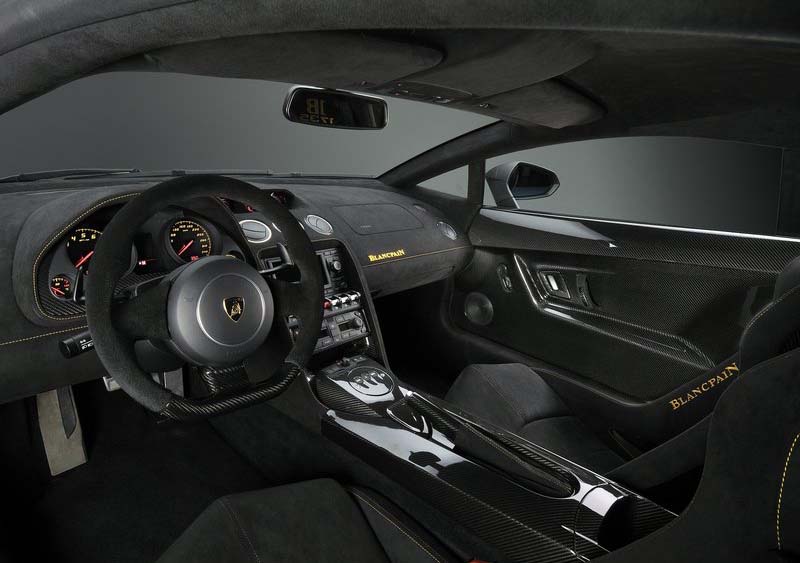
The interior of the Blancpain Edition further reinforces the extremely sporty character of the Gallardo without sacrificing the comfort of the driver and passenger. The entire interior is finished in black Alcantara with yellow accents and visible carbon-fiber. The Blancpain logo is placed on the exterior and also featured on the seats and cockpit in yellow stitching. Propulsion for the Lamborghini Gallardo LP570-4 Blancpain Edition comes courtesy of the 570 hp V10 power unit from the series Superleggera production car - as is the case for the Super Trofeo race car. Superb traction from the all-wheel drive ensures perfect stability in every situation.

The super sports car from Sant'Agata Bolognese boasts a dry weight of no more than 1340 kilograms (2954 lb) - the lightest road-going model in Lamborghini's range.

One key factor is the exterior and interior components made from carbon-fiber. Carbon-fiber is ideal for the manufacture of sports cars as its use allows for weight reduction and improved mechanical features. The car's performance is thus enhanced thanks to a better power-to-weight ratio and reduced total mass, which means that CO2 emissions are also lower.

The V10 power unit with 5.2 liters (317.6 cu in) of displacement generates 419 kW (570 hp) in the Lamborghini Gallardo LP570-4 Blancpain Edition. This puts the power-to-weight ratio of the vehicle at only 2.35 kilograms (5.18 lb) per hp and guarantees breathtaking performance. This super sports car handles the dash from zero to 100 km/h (0-62 mph) in 3.4 seconds and flies past the 200 km/h (124 mph) mark only 6.8 seconds later, ultimately exceeding 320 km/h (199 mph).
Read More

Maybach 62 S, 2007

 
 Maybach 62 S, 2007

Maybach, the luxury brand with an illustrious past, re-established just four years ago, is adding a fourth variant to its line-up in the shape of the newly developed 62 S model. The "S" stands for "Special" and draws attention to the fact that the Maybach engineers at the Sindelfingen-based Manufaktur workshops have incorporated a wealth of meticulously developed, special features specified by their highly discerning customers into the new 62 S model. The result is a new dimension in travelling comfort, especially for the passengers in the generously proportioned rear compartment of the new high-end luxury saloon. Not to mention a prodigious power output thanks to the enhanced potency of the twelve-cylinder engine developing 450 kW/612 hp, making the new 62 S model the world's most powerful chauffeur-driven saloon in series production.

The new flagship model in the Maybach range is celebrating its world premiere at the "Auto China 2006" international motor show in Beijing in November - a move which expends its range of high-end luxury saloons. The Maybach 62 S is primarily designed to be chauffeur-driven and meets the very highest of standards in terms of spaciousness, smoothness and comfort - for a truly relaxing ride - and dynamism for saving that most precious of commodities: time. Precisely what is needed in these increasingly frenetic times.

The exterior boasting a dynamically elegant appearance
Prominent exterior features accentuate the dynamic presence of the new Maybach 62 S and clearly distinguish it from the 62 model. These include a modified front end with a strikingly redesigned radiator grille as well as new, distinctive 20-inch spoked wheels and a modified light-cluster design. Like the 57 S model, the new Maybach 62 S boasts lavish single-tone paintwork in black or silver, both of which are available exclusively for the "S" models. Alternatively, customers can now specify a special paint finish in shimmering white. Discreet "62 S" lettering adorns the front wings beneath the A pillars and the boot lid, while a modified rear apron with two integral, trapezoidal exhaust tailpipes hints strongly at the immense performance potential of the 62 S. This dynamic and elegant appearance puts the Maybach 62 S in a league of its own when it comes to luxurious chauffeur-driven cars.

The interior
The contemporary Maybach interpretation of lavish luxury, consummate comfort and superlative dynamism is also reflected in the interior of the 62 S. Here high-grade materials are hand-finished to perfection for a distinctive and particularly exclusive look, all in inimitable Maybach style. Carefully coordinated applications of exquisite piano lacquer and sporty carbon or anthracite poplar create an atmosphere of dynamic elegance both in the rear compartment and in the driver's direct field of vision and activity. Newly designed, high-grade leather upholstery tastefully accentuates this overall impression.

12-cylinder powerplant and comfort-tuned chassis
Effortlessly superior performance in any situation comes courtesy of a Mercedes-AMG-enhanced V12 powerplant developing 45 kW/62 hp more than the engine specified for the Maybach 62. The twelve-cylinder engine in the Maybach 62 S has a displacement of six litres and an output of 450 kW/612 hp by virtue of a twin turbocharger and a water-type intercooler. The impressive maximum torque of 1000 Nm (electronically limited) is available over a wide engine speed range between 2000 and 4000 rpm. This provides even the most sportily inclined of Maybach drivers with effortless power reserves at all times. With acceleration from zero to 100 km/h in only 5.2 seconds, the new Maybach 62 S impressively demonstrates its outstanding performance potential. The top speed is electronically limited to 250 km/h in chauffeur-driven vehicles.

The exclusivity of the twelve-cylinder powerplant is underlined by a model plate on the cover bearing the signature of the Mercedes-AMG technician who assembled it by hand based on the now familiar "one man, one engine" principle.

In contrast to the sportier configuration of the 57 S model for owner-drivers, which features a stiffer and lower chassis, the Maybach engineers decided to retain the full spring travel for the 62 S in order to achieve an outstanding, practically unsurpassed level of ride comfort. In terms of comfort, the chassis marks the absolute pinnacle of automotive engineering. Yet it also offers a high degree of dynamic potential for reliably transferring the power to the road whatever the scenario. Hence the Maybach developers have succeeded in reconciling, to a near perfect degree, two very different requirements.

Maybach continues its rich tradition
The outstanding attributes of the Maybach 62 S set new standards at the high end of the passenger car industry and also continue the tradition of the legendary Maybach saloons which represented the elite in German and international carmaking circles back in the 1920s and 1930s. Even then, many Maybach cars were built and equipped to be chauffeur-driven - a tradition which the 62 S model is proud to honour.


Read More

Thursday, April 12, 2012

Cadillac Escalade Platinum, 2008


 Cadillac Escalade Platinum, 2008

The Cadillac announced the introduction of the 2008 Escalade Platinum, a special edition of the segment-leading large luxury SUV that takes Cadillac's dramatic design, elegance and technology to its fullest expression.

Making its world premiere alongside the upcoming Escalade Hybrid, Cadillac announced the Platinum edition will come to market in the spring of 2008 as the most luxurious model in the Escalade lineup. It rounds out a full series of Cadillac Platinum models, including the XLR Roadster, DTS luxury sedan and STS performance sedan. Each model in the Platinum lineup is characterized by elegant cabins featuring handcrafted leather, advanced technology and unique design details throughout.

Advanced technologies
Offered on Escalade and the extended-length Escalade ESV, the Platinum edition includes a blend of technical innovations and aesthetic enhancements. Escalade Platinum will be the world's first SUV to be equipped with Cadillac's advanced Magnetic Ride Control (MRC) technology.

Magnetic Ride Control, originally developed for performance vehicles such as the STS sedan, XLR Roadster and Chevrolet's legendary Corvette, is the world's fastest reacting suspension system and gives the Escalade Platinum more precise body motion control. It is a real-time damping system - "reading" the road in 1-milisecond intervals - that replaces conventional mechanical-valve shocks with electronically controlled shocks filled with a synthetic fluid containing minute iron particles. Under the presence of magnetic charge, the iron particles align to provide damping resistance almost instantly.

Segment-first, innovative LED headlamps
Escalade Platinum will be the first SUV - and one of the first vehicles of any kind - to offer Light Emitting Diode (LED) headlamps. Used previously only on concept vehicles or exotic sports cars, LED headlamps mark another step in Cadillac's application of advanced lighting technology and design.

LED headlamps emit a greatly more precise light pattern, while emulating the characteristics of natural daylight much more closely than traditional auto lighting. LEDs are environmentally friendly, using much less power and lasting more than 20 times longer than traditional halogen bulbs. LED headlamps will be an enhancement added to the Escalade Platinum in the summer of 2008, shortly after the start of production of the Platinum model itself in the spring of 2008.

Dramatic exterior, elegant interior
Escalade Platinum also elevates the already-dramatic design of Escalade. The exterior features a unique front fascia and grille patterned after Cadillac's acclaimed and hot-selling CTS sport sedan. The Platinum includes unique 22-inch wheels and wears exclusive Platinum exterior badges.

The cabin is the latest example of Cadillac's 21 st-century return to handcrafted luxury details. The instrument panel, center storage console and door trim are wrapped and stitched by hand. They feature decorative French seams that convey an elegantly tailored look and feel. Materials include rich leather on the instrument panel, with unique wood inlays and aluminum trim.

Aniline leather is unique to the Escalade Platinum and is used to trim the first- and second-row seats. Contrasting-color stitching is used on the French seams for a distinctive, luxurious appearance and the seatbacks feature embroidered Cadillac wreath and crest insignias. The leather-covered seats are comfortable and convenient, with the industry-exclusive power fold-and-tumble second-row seat feature that eases access to the third-row seat.

Additional standard interior features include Platinum-specific door sills and floor mats, a heated steering wheel and heated and cooled cup holders and a power liftgate that opens and closes with the touch of a button.

Also, the DVD entertainment system adds screens integrated into each front seat headrest, in addition to the existing roof mounted screen. Each front-row headrest screen has its own driver and input controls. The headrest units can be operated independently or in tandem. This system enables passengers in different seats to watch or listen to different entertainment choices, while leaving ultimate control with the driver. Escalade Platinum models will include the acclaimed Bose 5.1 Digital Surround system, as well as the eight-inch touch screen for DVD-based navigation and control of the DVD, CD, MP3 and XM Satellite radio entertainment.

Plentiful power
Platinum models are powered by the Escalade's exclusive 6.2L V-8 rated at 403 horsepower (301 kW) and 417 lb.-ft. of torque (565 Nm). It is an all-aluminum engine that uses v ariable valve timing (VVT) to optimize camshaft timing to improve low-rpm torque and high-rpm horsepower. The introduction of variable valve timing through the unique, dual-equal cam phaser is the industry's first application of VVT on a mass-produced V-8 overhead-valve engine.

A Hydra-Matic 6L80 six-speed automatic transmission is matched with the 6.2L engine. One of the industry's most advanced automatics, the 6L80 features clutch-to-clutch shifting and has a wide, 6.04:1 overall ratio - including two overdrive gears - that helps deliver an excellent balance of performance and fuel economy.
Read More