Thursday, February 10, 2011

Ferrari 599 GTB HY-KERS Concept, 2010

Ferrari 599 GTB HY-KERS Concept, 2010


Ferrari at the 2010 Geneva Motor Show gives the public its first glimpse of the HY-KERS vettura laboratorio which can reduce CO2 emissions by 35 per cent on the combined cycle (ECE + EUDC). The HY-KERS is based on the 599 GTB Fiorano but importantly, the technology may one day be fitted to all future Ferraris, 8- and 12-cylinders alike, regardless of their engine position. Thanks to ongoing research combined with experience gained in Formula 1, the new technology developed at Maranello actually accentuates the cars' sporty character and driving involvement.

One of the principle objectives of the project is ensuring that Ferrari will be in a position to comply with future CO2 emissions standards, particularly in terms of the urban cycle. City driving is traditionally where sports cars are most penalised as their engines are designed for maximum efficiency and performance at high revs, whereas the urban cycle involves low revs and low engine loads.

There are many original aspects to the new Ferrari hybrid transmission, starting with its architecture. Firstly, weight distribution has not been altered. This is thanks to positioning the batteries below the floorpan of the car, and the use of a compact electric motor coupled to the rear of the F1 dual-clutch gearbox. Not only does this layout not affect dynamic performance, it actually improves it, by lowering the centre of gravity. Cockpit room and luggage space are also unaffected.

Maranello's engineers also employed Ferrari's track experience in the design, engineering and manufacture of this innovative electric motor which produces over 100 hp. The algorithms and control logics controlling the torque, traction and braking distribution functions are directly derived from Formula 1.

The solution adopted for the HY-KERS represents just one of the possible technologies for the future, but in the meantime Ferrari continues to evolve its models and increase their overall efficiency. Thus research continues into reducing drag, improving rolling resistance of tyres and lowering weight as well as working on reducing engine friction to increase efficiency.

Ferrari's research into reducing energy consumption has not been focused merely on its cars but also extends to the various production methods employed throughout the Maranello factory where the entire manufacturing process is carried out, from the foundry to the final assembly. In the course of 2010, Ferrari will cut CO2 emissions by 30,000 tons (-40 per cent) and Particulate Matter (PM) levels by 65 per cent. This will be achieved thanks to the company's photovoltaic system and Italy's largest trigeneration plant (which produces electricity, hot and cold water), making Ferrari entirely self-sufficient from an energy point of view. The reduction also means that Ferrari will meet the Kyoto protocol objectives a full 10 years ahead of schedule and with double the figure imposed on Europe.
Read More

Ferrari 599 GTB Fiorano HGTE, 2010

Ferrari 599 GTB Fiorano HGTE, 2010


When it first debuted, the Ferrari 599 GTB Fiorano set a new standard in terms of performance that remains a benchmark for new sports car development to this day. Now Ferrari is introducing the new Ferrari 599 GTB Fiorano HGTE (Handling Gran Turismo Evoluzione) package for the model to further underscore its sportiness and handling.

The package includes a modified set-up with stiffer springs and rear anti-roll bar as well as new calibration settings for the magnetorheological shock absorbers when the manettino is at its sportier settings. The ride height has also been lowered which in turn lowers the car's centre of gravity. This combined with the new set-up helps improve body control. The package also includes specifically optimised tyres featuring a compound that offers even better grip.

The car's electronics have also evolved to ensure even more prompt response to driver commands. The F1 gearbox's shifts are now even faster in high-performance settings, while a new engine software strategy has improved accelerator response.

The exhaust silencer has also been modified with the result producing an even more marked and thrilling sound under hard usage whilst still delivering just the right comfort levels at cruising speed.
The new seats are trimmed in a new two-tone combination of leather with black Alcantara inserts, and the seat backs are trimmed entirely in carbon-fibre. Embroidered in contrasting stitching on the headrest are a Prancing Horse and the words "Handling GTE".
Read More

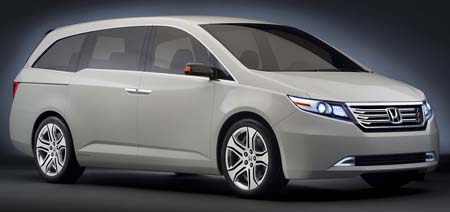
Honda Odyssey Concept, 2010

 Honda Odyssey Concept, 2010


 The Honda Odyssey Concept, on display at the 2010 Chicago Auto Show, introduces a sleek and distinctive exterior styling direction for the next generation of the industry's best-selling minivan, set to debut this fall, American Honda Motor Co., Inc., announced today.

The Honda Odyssey Concept dramatically departs from conventional minivan styling with its low and wide stance, highlighted by a "lightning-bolt" beltline that further distinguishes the vehicle's profile. Compared to the 2009 Honda Odyssey, the Concept's slightly lower roofline (-1.0 inch) and wider stance (+1.4 inch) contribute to a sleeker, stronger and more dynamic presence with improved aerodynamics that help increase fuel economy. Forthcoming improvements to the production Honda Odyssey's interior are designed to further enhance the current model's accommodating space for people and cargo.

The steeply raked front and rear roof pillars, unique side-glass profile, chamfered roof line, and tapered rear cabin shape combine to create a dynamic and distinctive appearance from any perspective. The lightning-bolt beltline dives toward the rear of the vehicle emphasizing the new Honda Odyssey's sporty appearance while enhancing outward visibility for third-row passengers. Aggressive body-to-wheel proportions reduce the perception of vertical height common to most minivan designs. Fender flares further accent the vehicle's securely planted and stylish persona. The concept vehicle's projector beam headlights, LED taillights and form-fit fog lights further heighten the sophisticated quality of the design.

Enhanced aerodynamics and advanced powertrain technologies will contribute to the next-generation Honda Odyssey's increased fuel efficiency. The all-new 2011 Honda Odyssey is expected to achieve an EPA-estimated fuel economy rating of 19 city/28 highway miles-per gallon on select models (preliminary estimate determined by Honda).

Currently in its third generation, the Honda Odyssey's unique array of features, including its superior driving dynamics, 3rd-Row Magic Seat and efficient i-VTEC V-6 engine with three-mode Variable Cylinder Management™ (available) all combine to offer a sophisticated environment with room for up to eight people (seven on Odyssey LX). The Odyssey has been America's best-selling minivan since 2008 and is produced exclusively in Alabama by Honda Manufacturing of Alabama (using domestic and globally sourced parts). Both the concept and production vehicles, along with all development activity for the 2011 Odyssey, are being designed at Honda R&D Americas in Torrance, California, and Raymond, Ohio.

The Honda Odyssey has won numerous awards and critical acclaim. Recent accolades include the Edmunds.com 2010 "Top Recommended" minivan award, U.S. News and World Report 2010 "Best Minivan for the Money" award, Automotive Lease Guide 2010 "Best Minivan for the Money," the Kelley Blue Book award as one of the ten "Best New Family Vehicles of 2009" and "2009 Best Resale Value Award" in the van category, which recognizes vehicles that are expected to have segment-leading resale value after five years of ownership.

Honda Odyssey Concept Basic Dimensions
    * Length: 202.8"
    * Width: 78.5"
    * Height: 68.3"
    * Wheelbase: 118.1"

Read More

Wednesday, February 9, 2011

Opel Astra, 2010

Opel Astra, 2010


The new Opel Astra brings into the compact class its own interpretation of the brand's award-winning design language of combining sculptural artistry with German precision first seen in the Opel Insignia. Its strong sporty lines and elegant details add to a new handsome look.

The exterior of the new generation Opel Astra, which debuts in September 2009 at the IAA in Frankfurt, boasts a strong cab-forward, fluid silhouette. Inside, high quality materials and a total re-think of the design add to the excitement of driving a compact car. Moreover, Opel has added innovative extras - higher quality materials, more storage, improved seats and safer bumpers - to give the Opel Astra comfort, health and safety features not usually seen in the compact class.

The exterior design gives Opel philosophy a new twist
Designers have given Opel's new philosophy an interpretation fitting for the compact class using the same wing and blade styling cues first introduced on the mid-sized Insignia. Sculpted into the side panels of the new generation Opel Astra, the blade sweeps rear ward and upward, connecting with the side window line, giving the car balance and harmony. Eagle eye-shaped headlamps that encompass the prominent signature wing daytime running lights give the Opel Astra face a low, sporty character.

A graceful flowing silhouette connects the muscular shoulder lines with an expressive rear to make it sporty yet elegant. On the front fascia, the next generation Opel Astra re-interprets the new Opel face by using the small upper grille to frame the new Opel logo, while emphasizing the bigger, bolder lower opening so as to create a sportier look.

The inside, design cues used to create driver-focused styling
Echoing the flowing forms of the bodywork, the hallmarks of the interior are sweeping lines and shapes that are executed with care. Interior designers achieve that, for instance, by creating bold, dynamic shapes that use materials intelligently. Everything drivers and passengers touch has been given a refined, high quality feel. In addition,
The interior also continues Opel's recurring wing and blade motifs. In this execution, the blade theme is expressed in details like the shape of the door grab handles and the trim for gearshift molding and steering wheel. The wing design cue is immediately evident in the warm, inviting wraparound instrument panel that embraces front seat occupants. It arcs across the cabin into the top of the door moldings.

Health, safety and comfort added via storage, seats and bumper improvements
The Opel Astra has added practicality through greatly increased storage and clever solutions for a compact class car that include a mini glove box on the driver's side and a drawer under the front passenger seat.
New, high quality seat technology brings added comfort and help to backs. In addition, safety was a major consideration in design. A new, intelligent bumper is intended to minimize damage in front and rear collisions, reducing injury to pedestrians and passengers and saving money in repairs and insurance.

The execution matched by great components and perceptual quality
Opel designers and engineers believe quality execution also must be matched by what the customer sees and feels. Such perceptual quality is particularly important in the interior, where the appearance and tactile properties of all materials must be on a par with their high standard of fit and finish.

The quality of the materials used in the new Astra is evident in such things as the grained, soft-touch surfaces, the textured panels, the quality of the décor, the chrome trim elements, and the feel of operating buttons and switches.
Read More

Opel Insignia Hatchback, 2009

Opel Insignia Hatchback, 2009


The new Opel Insignia highlights breathtaking design: Both body styles boast a flowing, muscular yet elegant silhouette with a coupé roofline. Designers of the new car deliberately created similar versions to retain the beauty of Opel's latest mid-sized car. The length of both the notch and hatchback, at 4,830 mm, and the wheelbase of 2,737 mm remain the same.

The Insignia's fuel consumption, CO2 emissions and driving dynamics benefit from the aerodynamic efficiency that was perfected during more than 650 hours in the wind tunnel. The result: A class-leading drag coefficient of 0.27.

Offering both the notchback and hatchback from the start is particularly important for markets such as the U.K. and France, where 5-door sedans traditionally enjoy a high market share of the mid-size class segment. German and Spanish customers, on the other hand, generally prefer notchback sedans. Prices for the U.K., Ireland, Germany, Austria and Switzerland will be announced July 22 in London and cars will hit German dealerships before the end of the year. Opel expects both models to sell in about equal numbers.

From the beginning, the Insignia will be launched with a broad line-up of motors. Seven engines will be available; all meet Euro 5 emissions standards and come coupled with six-speed transmissions. The four gasoline engines range from a four-cylinder 115 hp unit to a V6 with 260 hp. Three new direct-injection turbo-diesels exclusively developed for the Insignia feature a displacement of 2.0 liters and power outputs spanning from 110 to 160 hp.

The newly developed chassis can be enhanced with the innovative, integrated FlexRide mechatronic system, as well as the sophisticated Adaptive 4x4. Its lightning-fast distribution of torque over the four wheels ensures top stability and traction while improving dynamic handling performance.
Read More

Opel Insignia, 2009

Opel Insignia, 2009


The Opel Insignia elegant styling can be summed up as sculptural artistry meets German precision - a mantra that will be chanted in Opel models moving forward. With the Insignia, Opel successfully has brought the sporty coupé design to the mid-size sedan class without making any concessions in interior space. The Insignia offers three centimeters more knee room than the Vectra. The car also proves to be particularly efficient aerodynamically with a spectacular Cd of 0.27 which positively influences the economic, dynamic and acoustic qualities of the car. Both body variants have identical 4.830 mm length and share the same wheelbase of 2,737 mm.

The new car will hit dealerships in Germany before the end of 2008 and other markets as of January 2009 with a line-up of seven engines. All meet Euro 5 emissions standards and come with six-speed transmissions, either manual or automatic. The four gasoline engines range from a four-cylinder 115 hp unit to a V6 with 260 hp. The three new direct-injection turbo-diesels exclusively developed for the Opel Insignia feature displacement of 2.0 liters. They offer outputs spanning from 110 to 160 hp and excellent torque values ranging from 260 to 350 Nm. All combinations compare competitively in CO2 emissions.

Powerfully Sculpted Lines Give Opel Insignia its Dynamic Look
The design of the new Opel Insignia signals a paradigm shift for Opel by adding emotion back to the brand. Both the notch and hatchback of Opel's new car feature a flowing, muscular silhouette with a sporty roofline. The designers created a powerfully sculpted shape for the body and used the same design cues in the interior, giving the Insignia a premium feel.

Opel has a long successful tradition of building very aerodynamic cars. Just remember the spectacular 1990 Calibra and its Cd of 0.26. With a drag coefficient of 0.27, the Opel Insignia is more streamlined than competitors with underbody shields. The Insignia's fuel consumption and driving dynamics benefit from its sleek, flowing styling which was optimized during more than 650 hours in the wind tunnel.

Redefined design vocabulary
Like the signature crease on the hood, a blade form has been chiseled into the side, signposting a styling element that becomes another defining characteristic of future Opel cars. Other unmistakable design elements include a distinctive radiator grille with a newly-designed Opel emblem as well as sweeping front and rear light forms. The dynamic tapered shape of the wing lighting signature is another Opel Insignia DNA detail.

Echoing the exterior design, the shapes and surfaces of the interior also articulate this promise of exciting mobility and are crafted with high quality materials. The new car's dashboard wraps around from the instrument panel to the door in a very sophisticated way, embracing the occupants. The bold exterior "blade" graphic is echoed in the shape of the interior door grab handle, the steering wheel or the central gear-shift lever.

The designers focused on painstakingly refining the surfaces, carving the crisp intersecting lines and colors; testing the textures, feeling the materials and ensuring all the surface finishes were of the highest quality. At the same time, practical needs - such as good ergonomics and numerous storage compartments - also were given top priority. The orangish-red ambient light that warms the interior also will be found in future Opel models.

Powertrain
The new Opel Insignia launches with a exceptionally broad range of seven engines that all meet Euro 5 emissions standards. The four gasoline engines range from 115 to 260 hp completed with three new 2.0 liter turbo-diesels featuring power outputs of 110, 130 and 160 hp. In the coming months, the powertrain range will be expanded with new, more powerful motors. In addition, an ecoFLEX version with especially low CO2 emissions will join the lineup. In each of their respective power output category, these engines are among the best or the best in fuel consumption and CO2 emissions.

The three diesel and four gasoline engines all come with a six-speed manual gearbox. The top diesel and gasoline units also are available with a six-speed automatic transmission. All-wheel-drive (see chassis chapter) versions, too, can be ordered with the 2.0 Turbo and 2.8 V6 Turbo gasoline engines and later with the more powerful diesel engines.

Opel Insignia Gasoline Engines
The 2.0-liter turbo is new in the Opel mid-size class segment. The 220 hp direct-injection engine is closely related to the sporty unit in the Opel GT. The all-aluminum engine is a powerhouse generating 350 Nm of torque from 2000 to 5200 rpm, with twin balancer shafts to ensure smooth running. Offering strong power allied to economic fuel consumption, it makes a perfect partner for the dynamic, comfortable Insignia. This engine also illustrates the downsizing policy at GM as this 2-liter 4 cylinder can compete with the competitors 5- and 6 cylinders in performance but with lower fuel consumption and emissions.

The entry level gasoline engines are the 1.6 ECOTEC (85 kW/115 hp) and 1.8 ECOTEC (103 kW/140 hp) recently introduced on other models of the Opel range. The top of the line gasoline engine is the 2.8 V6 Turbo developing a generous 191 kW (260 hp) and 350 Nm of torque between 1800 and 4500 rpm.

All gasoline engines feature camshaft phasing - on both intake and outlet sides for the four cylinder units, and on the intake side for the V6. Variable valve timing increases torque at low rpm and plays an important role in reducing fuel consumption as well as meeting new Euro 5 emissions standards.

Opel Insignia Diesel Engines
The new-generation Opel diesel engines in the Insignia feature 2.0-liter displacement, more power and torque, as well as excellent fuel economy. The Opel Insignia launches with 3 versions of the 2.0 CDTI engine developing respectively 81 kW/110 hp, 96 kW/130 hp and 118 kW/160 hp. This last engine variant also powers the Opel Insignia ecoFLEX with lower fuel consumptions and CO2 emissions. All versions come with a maintenance-free diesel particulate filter as standard and meet Euro 5 emission levels.

The engines have two overhead camshafts, four valves per cylinder, and common-rail, multiple fuel direct injection, together with a variable geometry turbocharger for a rapid throttle response at low rpm. Thanks to the large 70-liter tank, the diesel models boast a driving range of over 1200 km between visits to the gas station.
Read More

Tuesday, February 8, 2011

Ford Focus Estate, 2011

Ford Focus Estate, 2011


The next-generation Ford Focus Estate is the fifth vehicle to be revealed from Ford Motor Company's new global C-segment platform that will underpin at least ten vehicles around the world and account for two million units of annual production by 2012.
Revealed so far are the new Ford C-MAX and Grand C-MAX models at Frankfurt 2009, the next-generation Ford Focus 4-door and 5-door cars at the 2010 North American International Auto Show, and now the Estate at Geneva.

At Geneva, Ford is also confirming that a global performance vehicle will be developed as part of the next-generation Ford Focus range, and that it will be powered by a version of the 4-cylinder Ford EcoBoost engine family.

Ford Focus Estate Targets Major Customer Base
The attractive next-generation Ford Focus Estate is a crucial model for the European market in particular, as around one third of all Focus customers choose this bodystyle. In some markets, such as Italy and Germany, the estate derivative represents more than half of all Ford Focus cars sold.

With its rakish appearance, the new Ford Focus Estate also makes a design statement and provides the ideal balance of dynamic looks and functional practicality. Full-length integrated roof rails enhance the estate's attractive kinetic design, while the tailgate has a self-closing function and neatly incorporates a compact roof spoiler.
Overall, the C-car segment in Europe remains relatively stable and accounts for around a third of total car sales with roughly five million C-cars sold annually. Although many premium manufacturers have also moved into the segment in recent years, it is among the volume makers that the competition is most fierce.

The market has seen significant fragmentation in the last decade thanks to the development of new bodystyle derivatives beyond the traditional four-door sedan, five-door hatchback and estate models.

By 2012, six bodystyles will cover 85 per cent of customer requirements in the segment in Europe - the four-door sedan, the five-door hatch, the estate, the five-passenger MAV, seven-passenger MAV and the small SUV.
While the Ford Focus Estate will initially launch only in Europe, it has been designed to share the wide range of technologies, fuel efficient powertrains, great driving quality and high levels of craftsmanship that all of Ford's new global C-cars will deliver.

The Ford Focus Estate debuts in the same vibrant Candy Red body colour which was first shown to great acclaim on the new Ford Focus five-door model unveiled at the North American International Motor Show in Detroit.
Read More

Ford Fiesta, 2011

Ford Fiesta, 2011


The Ford Fiesta is the next milestone under the ONE Ford plan to design and develop vehicles that meet the differing needs, wants and expectations of customers around the world. More than 500,000 Fiestas have already sold to customers in Europe and Asia.

Kinetics and aesthetics
Kinetic design imparts a sense of movement - even while standing still - harmonizing character elements to reflect global Ford identity, enabling Ford Fiesta to project its own air of confidence, style and individuality. Fiesta targets a youthful "design progressive" mind-set, a consumer group that values style and diversity as worthy assets.

Up front, Ford Fiesta sports the global Ford face, centering the Blue Oval badge on the grille over the signature inverted trapezoid lower grille opening. These subtle cues engender familiarity across the portfolio, providing aesthetic linkage between the distinctive new Ford Taurus, the fuel-efficient midsize Fusion and the bold Fiesta.

Adding eyes to the Ford Fiesta face are sweeping, elongated headlamps that frame and connect the hood to muscular, sculpted front fenders. Available in sporty five-door hatchback or four-door sedan body styles, Ford Fiesta provides ample space for occupants and their gear.
The Ford Fiesta design is further enhanced with a choice of nine vivid new colors. From Bright Magenta through Lime Squeeze to Blue Flame, Fiesta's broad color palette - more available colors than any other segment competitors - instills vibrant individuality.

Inside Ford Fiesta
Ford Fiesta is as dramatic on the inside as it is on the outside. Boldly sculpted surfaces, contrasting colors and comfortable, supportive materials make the interior as individual as the driver.

The instrument panel centerstack - focal point of the new Fiesta interior - was designed to feel as useful and familiar as the keypad on a mobile phone.

Soft, sculptured surfaces and the centerstack layout provide the Ford Fiesta with a sense of harmony. Intuitive switchgear placement, comfort zone seating and available ambient lighting allow a driver to maximize the mood with seven complementary colors - switchable among three levels of intensity - for interior accent lighting.

Fun, with fuel efficiency
Ford Fiesta's flowing sculpted hood covers a 1.6-liter DOHC I-4 engine with an estimated 119 horsepower and 109 ft.-lbs. of torque. Spirited performance and fuel-efficient economy are signature attributes with the Ford Fiesta expected to deliver best-in-class fuel economy at 40 mpg.

Ford Fiesta's advanced 1.6-liter engine features Twin Independent Variable Camshaft Timing (Ti-VCT) allowing the engine to be downsized for fuel economy while continuously optimizing camshaft phasing for throttle response, performance and flexibility.
Big results from a small package are possible with several new technologies in this new global engine, including an advanced new front end accessory drive (FEAD) belt with stretchy dynamics to improve the engine's thermal dynamics. The elasticity in this new drive belt eliminates the need for a belt tensioner and contributes to overall fuel economy.

Ford Fiesta features a standard five-speed manual transaxle with gear ratios selected to offer spirited off-the-line performance and exceptional fuel economy for drivers who desire three pedals and a stick shift to maximize driving experience.
Specially tuned front struts, bushings, dampers, stabilizer bars and a rear twist-beam axle keep Ford Fiesta sure-footed and firmly planted. Sporty, European driving dynamics prevail.

Automatically game-changing
An available all-new North American industry-exclusive PowerShift six-speed automatic transmission combines the responsive performance and fuel economy of a manual transmission with the convenience of a traditional automatic in one advanced, dual dry-clutch package.

Twin internal clutches keep the PowerShift in constant mesh, always optimizing for maximum responsiveness or fuel efficiency, depending on input received from the driver's foot on the accelerator pedal.
This "dry" transmission operates with sealed internal lubrication, reducing internal friction and adding to Ford Fiesta fuel economy. The lack of pumps and hoses reduces under-hood complexity, saves weight and also contributes to fuel efficiency.
PowerShift has been proven in Ford's European market and will redefine North American small car segment expectations for responsive shifting and fuel efficiency.

Power steering conserves fuel
For confidence-inspiring on-road dynamics, Ford Fiesta features Electric Power Assist Steering (EPAS) which reduces complexity while saving weight and fuel. This advanced system is speed-sensitive - providing optimized assist based on speed, cornering forces and acceleration or deceleration.
The Ford is aggressively moving to EPAS across its product lineup. The system already is available in several Ford, Lincoln and Mercury nameplates, and by 2013 nearly 90 percent of Ford's lineup will offer this fuel saving technology.

EPAS also includes Pull-Drift Compensation to help Ford Fiesta track true regardless of road crown or side wind conditions. In addition, active nibble control helps detect and compensate for tire balance irregularity. Both features - enabled by EPAS - are class-exclusives.

Read More

Infiniti M, 2011

Infiniti M, 2011


With the Infiniti M a new style of performance saloon - brimming with passion, craftsmanship and driver appeal - comes to Europe in 2010 as the world's newest luxury automotive brand Infiniti faces up to the traditional executive car hierarchy for the first time. Power, performance and technology all come together with signature Infiniti sophistication in the all-new Infiniti M Line which makes its official public debut in the USA, prior to European sales starting September 2010.

Featuring industry-first features, advanced Safety Shield technology and displaying Infiniti's unswerving commitment to passionate design and a rewarding drive, Infiniti's latest example of Inspired Performance will be the first Infiniti M to be available in all of Infiniti's 34 world markets - including Western Europe.

A more exclusive alternative to the traditional stalwarts of the executive class, such as the BMW 5-series and Mercedes E-Class, the Infiniti M Line goes on sale in European showrooms from September 2010 with petrol and diesel V6 power options, while an innovative petrol-electric hybrid is due to join the range in Europe in 2011.

The Infiniti M Line takes Infiniti's saloon range in Europe - which also includes the Infiniti G37 - to a higher new level, inside, outside and on the road, too. The Infiniti M combines rear-wheel-drive poise with impeccable luxury credentials in a 4945mm-long saloon with space to spare inside the best designed and finished cabin that Infiniti has ever offered. As flagship saloon for the brand, the Infiniti M Line also revels in the uniqueness that is Infiniti, from the flowing lines of the Essence concept car-inspired profile and the integrity of the natural materials used, to the pledge of an utterly hassle-free ownership experience.

Infiniti's most technologically advanced and beautiful saloon yet, the third-generation Infiniti M will bring with it to Europe its unimpeachable reputation for quality among American luxury car-buyers. Every Infiniti M model will also arrive designed and equipped to succeed in some of the world's toughest executive car markets, blending qualities that have made it a popular car in the US with the high-performance abilities needed to compete on European roads.

The new Infiniti M Line has been able to call on key Infiniti strengths in order to satisfy more demanding drivers. These include lightweight componentry, adaptive technology, race-bred engine design, sophisticated chassis design with almost perfect weight distribution and proven double-wishbone suspension with the availability in some models of Infiniti's acclaimed sports handling technology, 4-Wheel Active Steering (4WAS). To the benefit of looks, ride and cabin room, the M also benefits from one of the longest wheelbases in the class.

The new Infiniti M has its first outing - in the metal - at an unveiling in Beverly Hills, California, prior to US sales commencing in the spring of 2010. An earlier debut, in August this year, was as a "virtual" car created in 3D by video mapping - presaging a trend for "firsts" that the new Infiniti M Line is well placed to expand upon.

The body
The M's design is signature Infiniti, its subtle curves and complex surfacing endowing it with an emotional draw that goes beyond the colder, more austere class norm. Its deeply sculpted door surfaces and front bumper section add distinction and a sense of both aggression and intrigue. The body crease below the glasshouse is the clearest of many design cues picked up from Essence, the stunning Infiniti concept car that made its debut at the Geneva Auto Show early in 2009.

A look inside
The new Infiniti M has an interior every bit as carefully crafted as its exterior. The result of extensive research by engineers and designers into every aspect of the cabin, from the shape of the switches to the softness of the textures, the aim was to create Infiniti's best saloon car interior ever, with human warmth and an outstanding level of luxury appointments. And all with that most important of Infiniti traits: a clear focus on the driver.

Mission accomplished then. The Infiniti M cabin's wow factor begins as soon as a door is opened: there can be no missing the perception of quality in everything that is seen, touched and felt - right down to the smallest details. Combining vibrant, Japanese-influenced design and luxury materials, it is an immediately alluring, sensual place, as well as notably spacious. The M's wheelbase, at 2900mm, is longer than that of most competitors and this shows inside where there is plenty of room for five adults.

Blind Sport Intervention (BSI)
The latest in a list of world-first safety features from Infiniti, BSI takes blind-spot technology to another level by introducing an element of side collision protection. As well as giving the driver both visual and audible warnings of another vehicle in the blind-spot area which is detected by using radar, BSI intervenes if the driver ignores the warnings and attempts to steer into the other vehicle's path. The intervention is in the form of a directional adjustment, executed automatically. This is achieved by selective braking on one side of the car to create a "yaw" effect that eases the vehicle back into its original lane.

Active Noise Control (ANC)
By identifying undesirable sounds in the cabin and then playing back through the speakers sound waves of opposite phase, the original noises are cancelled out, making the M's interior a quieter, more restful place to be. The system is aimed at reducing undesirable low-frequency engine sounds only. Infiniti M models with the 16-speaker Bose® Studio Surround® sound system are equipped with Bose Engine Harmonic Cancellation (EHC) which is even more effective at controlling unwanted noises.

Infiniti Drive
The M's throttle sensitivity and transmission mapping are fine tuned according to which of four driver-selectable modes is engaged via a switch positioned behind the gear lever: Standard, Eco, Sport and Snow. The Eco mode utilizes green and yellow lights on the instrument panel to provide feedback on fuel efficiency. Eco mode also introduces a new Infiniti concept known as the Eco Pedal. If driving too aggressively, the driver will feel the accelerator pedal "push back" to indicate fuel is being wasted. Sport mode changes the automatic shift points and enhances throttle response for increased performance. It will also adjust the 4WAS for a nimbler feel and raise the ESP intervention level.

Forest Air
Infiniti believes the quality of the air within a car's cabin has a direct bearing on the well-being of driver and passengers. Which is why it developed Forest Air, Infiniti's most advanced climate control system that makes its debut in the Infiniti M Line (depending on model). The system offers unrivalled temperature, humidity and pollution control while re-creating the gentle breezes and subtle scents of an environment known to promote alertness and relieve stress: the forest.

ESP with Dynamic Cornering Enhancement
The Infiniti M Line benefits from Infiniti's latest electronic stability program which optimizes control of braking and engine torque on individual wheels to achieve smoother and more stable cornering. The system can apply selective braking to help create increased steering response when rapid changes of direction are required, such as in S bends or fast lane-change manoeuvres.

Safety Shield
For the 2011-model year M Line, Infiniti's 360-degree "bubble of protection" around the car known as the Safety Shield becomes more complete than ever. New features such as Blind Spot Intervention and Dynamic Cornering Enhancement are fully integrated into existing Safety Shield technology such as Intelligent Cruise Control (full speed range), Lane Departure Warning (LDW) and Lane Departure Prevention (LDP), Distance Control Assist (DCA), Intelligent Brake Assist (IBA) with Forward Collision Warning (FCW) and Front Pre-Crash Seat Belts.
Read More

Monday, February 7, 2011

Bentley Continental Supersports Convertible, 2011

Bentley Continental Supersports Convertible, 2011


The Bentley Continental Supersports Convertible further strengthens Bentley's supercar range, following the introduction of the Bentley Continental Supersports Coupé in 2009. The new Supersports Convertible, with the same 630PS (621bhp/463kW) twin-turbocharged W12 engine, is the fastest, most potent drop-top Bentley has ever built, offering the ultimate Bentley driving experience in the world's most dramatic convertible.

A highly focussed, pure Bentley driving experience
With 630PS (621bhp) and 800Nm (590lb ft) of torque from its pioneering FlexFuel engine and new 'Quickshift' transmission, the Bentley Continental Supersports Convertible is the fastest drop-top Bentley has ever built. It accelerates from 0-60mph in 3.9 seconds (0-100km/h in 4.2 seconds) and, conditions permitting, can continue onto a top speed of 202mph (325km/h).

The increased power and torque are transmitted to the all-wheel drive system via an uprated and rapid six-speed Quickshift transmission, which more than halves shift times (to just 93 milliseconds) and maximises the new Convertible's enormous potential. The revised gearbox also has the ability to deliver double downshifts (sixth to fourth gear, for example) and improves acceleration across the entire gear range. To cope with the additional power and torque, the planetary gear set of the ZF transmission is also strengthened.

Positive torque during downshifts is achieved through engine and gearbox electronic controller interaction for extra throttle and fuel injection during the overrun. During transmission upshifts, fuel and ignition are cut momentarily to give faster mechanical shift times through torque reduction, also improving shift quality and durability.

Designing the 'extreme' Bentley convertible- where form follows function
The evolution of the Bentley Continental Supersports Convertible's design is very much a case of form following function, with new purposeful sculptural forms signalling the engineering changes beneath the skin. Key engineering-led design changes to the Supersports include:
    * Revised front air intakes and new bonnet vents to improve airflow and cooling
    * Flared rear wings to accommodate wider rear track
    * Discreet bootlid spoiler benefitting aerodynamic balance at high speeds

The increased power and torque of the W12 engine necessitated an additional 10 per cent airflow to the twin turbocharger intercoolers and cooling system. With extensive use of Computational Fluid Dynamics techniques, Bentley's designers responded with a purposeful and dramatic style, featuring large vertical intake apertures. Twin bonnet vents were added to ensure positive air extraction.

From the front, the radiator, lower grille and dual bonnet vents are finished in a striking Smoked Steel finish. Derived from an innovative technology normally used to apply a coating to luxury watches and specialised industrial tools, Physical Vapour Deposition (PVD) is a complex and time-consuming process that involves vaporised metal being deposited onto the surface of, in this case, stainless steel.

Giving a darker, more solid appearance, it is the first use of a PVD finish on stainless steel in the car industry. In addition to the Smoked Steel finishes, a gloss black finish to the headlamp casings and rear lamp clusters gives the Bentley Continental Supersports convertible's distinctive face and muscular rear additional visual impact.

Restyled - and more aerodynamic - door mirrors match the exterior paint choice and the window and door surrounds replace polished stainless steel with a Smoked Steel finish to match the front grille. Eye-catching, black gloss Bentley-branded brake calipers act on the carbon ceramic brakes. Surrounding the brakes are the unique 20-inch, forged alloy wheels with Smoked Steel-finish which are exclusive to Supersports models. Large diameter tailpipe trims round out the car's purposeful stance when viewed from the rear. Beneath the bonnet Supersports badges grace the cover of the 630PS (621bhp) W12 engine.

The Bentley Continental Supersports Convertible has an electrically operated, three-layer fabric hood with advanced acoustic insulation to provide superb levels of refinement and comfort when raised. A choice of eight hood colours are available, including a new Dark Grey Metallic option, which is achieved by weaving a 'grey' acrylic fibre with a semi-transparent 'metallic effect' fibre in a twill weave construction to create a directional colour effect.
Read More

Bentley Continental Supersports, 2010

Bentley Continental Supersports, 2010


The Bentley Continental Supersports is the fastest and most powerful Bentley ever. It is the extreme Bentley, a muscular two-seater that delivers supercar performance and a highly focused driving experience. The Bentley Continental Supersports is also the first Bentley capable of running on both petrol (gasoline) and biofuel, pioneering the use of FlexFuel technology in the luxury sector. This represents stage one of the company's commitment to make its complete model range compatible with renewable fuels by 2012. Available worldwide from autumn 2009, the Bentley Continental Supersports will be FlexFuel compatible in the majority of markets from launch with North American cars offering the capability by summer 2010, following regulatory approval.

The Bentley Continental Supersports began as an 'under the radar' project exploring the possibilities of weight reduction on the Bentley Continental GT but with more power and torque. A largely experimental process crystallised over a period of 24 months into an official new car programme, driven by the passion and enthusiasm of a small group of Bentley engineers and designers. The results are dramatic. With 630PS (621 bhp) and new 'Quickshift' transmission that halves shift times, the Bentley Continental Supersports sets new performance benchmarks for Bentley. It accelerates from 0-60 mph in 3.7 seconds (0-100 km/h in 3.9 seconds) with a top speed of 204 mph (329 km/h).

The supercar performance is complemented by an array of chassis enhancements including retuned steering and suspension, utilising lighter weight components, retuned dampers and anti-roll bars. Agility is further sharpened by the 40:60 rear-biased torque split for the all-wheel drive system, a wider rear track, bespoke lightweight 20-inch alloy wheels and a unique electronic stability programme. Carbon ceramic brakes are standard fitment, benefiting steering response, grip and ride comfort, while saving weight. Overall, the engineering team have achieved a weight reduction of 110 kg (243 lb) compared with the Bentley Continental GT Speed.

The evolution of the Bentley Continental Supersports' design is very much a case of 'form following function' with new purposeful sculptural forms signalling the engineering changes beneath the skin. For example, the increased power and torque of the W12 engine necessitated additional airflow to the twin turbocharger intercoolers and cooling system. Bentley's designers responded with a purposeful and dramatic style that features large vertical intake apertures and twin bonnet vents. Similarly, new flared rear wings that accommodate the 50 mm (2 inches) wider rear track are designed to emphasise the powerful stance of this ultra-high performance coupe. The resultant Supersports style combines the looks of the iconic Continental GT with a new and distinctive appearance that reflects its more extreme character.

The Bentley Continental Supersports is further distinguished from its Continental coupe stable mates by a unique dark-smoked steel finish to all exterior 'brightware', including front grilles, lamp bezels, window surrounds and wheels. A complex 'Physical Vapour Deposition' process is applied to all stainless steel components to give a lustrous and highly durable finish. A car industry first, this process is normally used as a coating on industrial tools, watches and even hip replacement joints.

Fully embracing the extreme spirit of the Supersports, Bentley's interior designers have created a unique ambience. The cockpit represents a dramatic reinterpretation of Bentley interior design in which carbon fibre and Alcantara not only convey a sporting and contemporary style but also reduce weight. The Bentley Continental Supersports is a strict two-seater featuring all-new lightweight sports seats with carbon fibre clamshell rear panels. In the rear compartment, the seats are replaced by a stowage deck with a carbon fibre luggage retaining beam. The new interior also provides a showcase for the skills of Bentley's craftsmen and women at the company's factory in Crewe, England. Signature premium grade leather and brightware are complemented by carbon fibre panels, replacing traditional wood veneers.

The Bentley Continental Supersports is capable of running on either petrol and E85 biofuel or any combination of the two. E85 biofuel can offer a reduction of up to 70 per cent in CO2 emissions on a 'well-to-wheel' basis. Well-to-wheel is a measurement of a fuel's net CO2 contribution to the atmosphere, not just tailpipe emissions. It is a way of quantifying how much CO2 a fuel emits from its growth or extraction (well) to its combustion or deployment (wheel). It includes refinement, distillation and transport of the fuel. The fuel supply system detects the blending ratio of the fuel in the tank and ensures that power and torque remain constant regardless of the ratio of petrol to biofuel. The result is seamless power delivery in the Bentley tradition.

The 'Supersports' name is inspired by the original two-seater 3-litre Supersports model introduced in 1925, itself an evolution of the 3-litre Speed. The lightweight, 85 bhp Supersports was the first production Bentley to reach 100 mph and was also renowned for the application of Le Mans-winning race technology.
Read More